Read an excerpt from THE SHORTEST HISTORY OF DELHI by John Zubrzycki!
The essential introduction to a city that has captivated imaginations for millennia.
Read an excerpt here:
Mirza Ghalib was born in 1797. His father, an officer in the Maharaja of Alwar's army, died when he was five. He was then looked after by his uncle, who was the governor of Agra and had served under Lord Lake in the Maratha war. His uncle's close contacts with the British worked in Ghalib's favour when he moved to Delhi at the age of fifteen, by which time he was already an established poet. William Fraser, whose love of poetry knew no bounds, became his close friend and benefactor.
Pampered from a young age, Ghalib found it hard to curb his spending habits, which quickly ate into the modest allowance he received from his family's estate. He made no secret of his love for wine and women. His tipple of choice was French wine, which he diluted with two or three parts of rose water, and without which he could not sleep. When it became expensive and hard to get, he switched to rum.
In 1847, Ghalib was charged and convicted of running a gambling den in his house. Overzealous authorities had caught him betting on chess games and sentenced him to jail for three months. Ghalib wore the conviction with pride. When chastised by his pious rival Sheikh Sahbai, he shot back: 'How can Sahbai be a poet? He has never tasted wine, nor has he ever gambled; he has not been beaten with slippers by lovers, nor has he once seen the inside of a jail.' His unorthodoxy extended to religious matters, once praising the Hindu holy city of Benares as the Mecca of India and wishing that he could renounce his Islamic faith, 'take the Hindu rosary in hand, and tie a sacred thread over my shoulder'.
While Ghalib's poetry was notoriously complex and metaphysical, that of Sheikh Ibrahim Zauq was smooth and simple. The poet laureate's poems, one of his admirers wrote, 'run through listeners' hearts like electricity... fall from the lips of the singers, and scatter colour through streets and bazaars'. Both primarily wrote ghazals, short poems usually comprising between five and twelve couplets. But two men could not have been more different. Mushairas featuring the rivals were major events, at which 'spectators would experience something of the euphoria of a cup tie', wrote Spear. 'Literary controversies were a substitute for political ones and their factions for political parties.'
These gatherings often took place at Delhi College, located near Ajmeri Gate. Established in the late eighteenth century as a madrassa providing a conventional Islamic education, it was reorganised in 1825 as an institute dedicated to Anglo-Oriental studies. In 1828, English classes were introduced, alongside Arabic, Urdu, Persian and Sanskrit. Although relatively few students studied English, the college became a melting pot, blending new ideas from England and Europe with the old cosmologies of Islam and Hinduism. Initially the British saw Delhi College as a vehicle for enabling 'natives' to acquire Western knowledge, thereby forming a class that was better acquainted with colonial priorities. Gradually, the curricula of traditional sciences changed. Students were given the option of learning Arabic by studying compilations of the Hadith or the fables of The Thousand and One Nights.
The Shortest History of Delhi
by John Zubrzycki
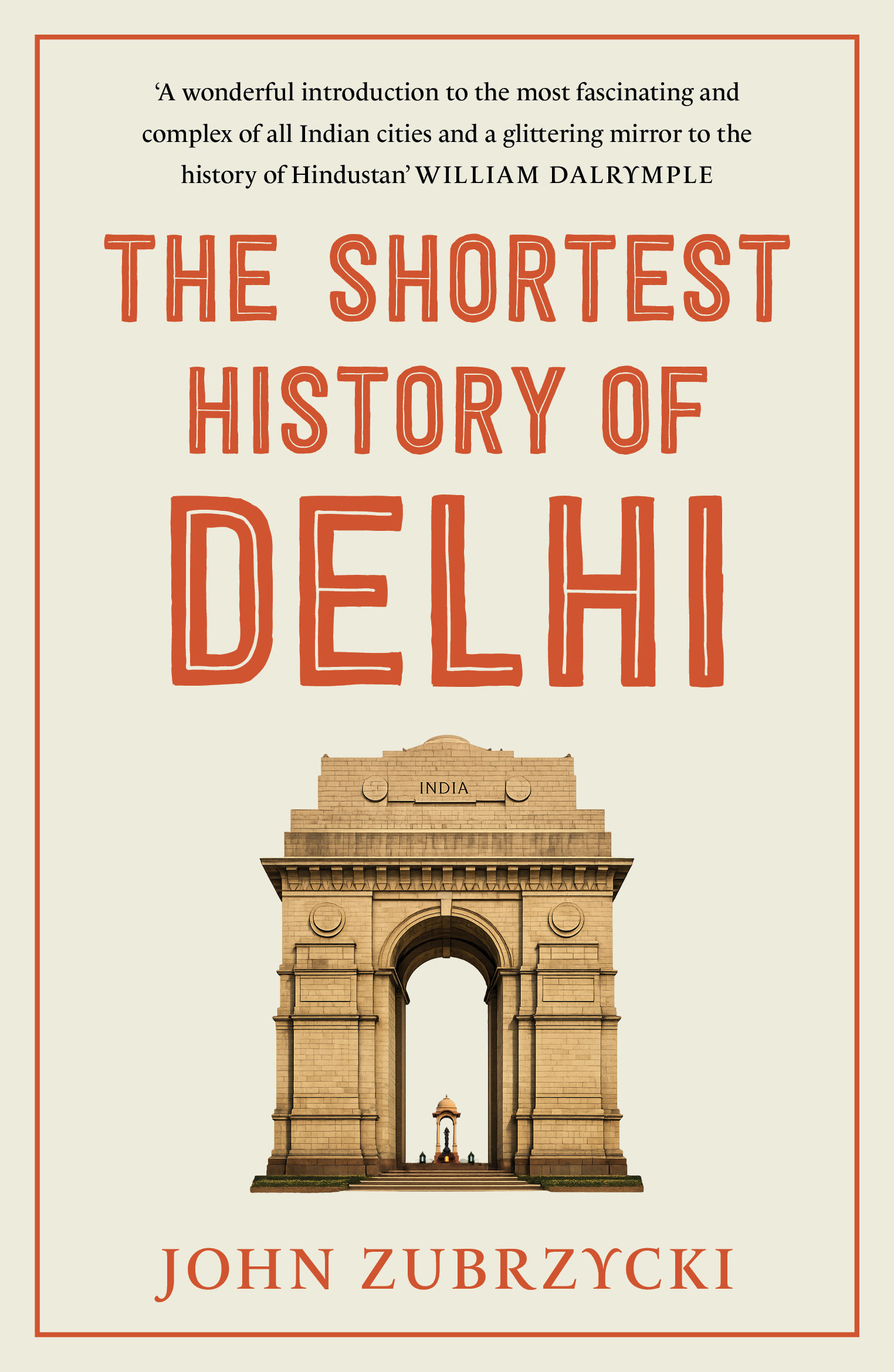
‘A wonderful introduction to the most fascinating and complex of all Indian cities and a glittering mirror to the history of Hindustan’ WILLIAM DALRYMPLE
‘A breathless and rambunctious romp … Delhi gets her newest dastango to sing her songs of beauty and loss’ IRA MUKHOTY
‘Essential reading for a meaningful introduction to Delhi’ SWAPNA LIDDLE
The essential introduction to a city that has captivated imaginations for millennia
Delhi, with its stories of intrigue and empire, decadence and artistry, destruction and rebirth, has been exhilarating travellers for centuries. Its history stretches back thousands of years, through invasions, empires and the struggle for independence.
This many-layered history can be seen on the streets of Delhi today – in ancient monuments to emperors, saints, princesses and eunuchs; in the domes of mosques clad in shimmering white marble; in stately Mughal gardens, and in the bustling laneways of its markets and neighbourhoods. Now, Delhi is a vast megalopolis, drawing people from all over the subcontinent – a cornucopia of religions, castes, languages and economic classes.
In The Shortest History of Delhi, John Zubrzycki pairs an invigorating account of Delhi’s past with an insider’s guide to the city today.